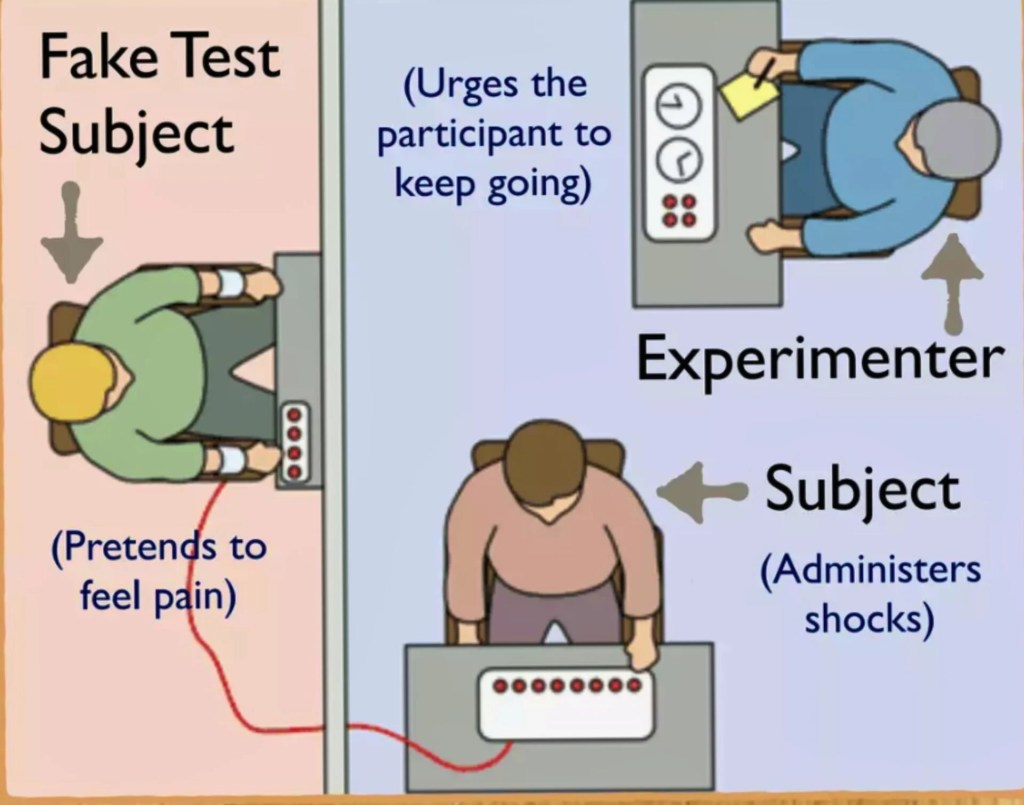
Obedience to authority is a fundamental aspect of human behavior that has been the subject of extensive psychological research. One of the most well-known studies in this area is the Milgram experiment, conducted by psychologist Stanley Milgram in the early 1960s. This experiment sought to explore how far individuals would go in obeying authority figures, even when their orders involved harming others. The results were both shocking and deeply insightful, revealing important aspects of human nature that remain relevant today—particularly in contexts where individuals carry out unlawful orders under the guise of obedience.
The Milgram Experiment: Structure and Findings
The Milgram experiment involved participants who were assigned the role of “teacher” in a learning exercise. They were tasked with asking questions to a “learner” (who was, in fact, an actor) and administering electric shocks for every incorrect answer. With each wrong response, the voltage of the shock increased, starting at 15 volts and progressing up to a maximum of 450 volts. While the shocks were fake, the participants were led to believe that they were real, and the intensity of the shocks was clearly labeled, with the highest level marked as dangerous.
The results were startling. A full 65% of participants continued to administer shocks up to the maximum 450 volts, despite hearing the “learner” express pain and distress. All participants reached at least the 300-volt level before some began to refuse to continue. Of the 40 participants in the study, 14 stopped early: 5 stopped at 300 volts, 4 at 315 volts, 2 at 330 volts, and 1 participant each at 345, 360, and 375 volts.
The experiment demonstrated that many people, when placed under the authority of an individual perceived as legitimate, would be willing to inflict harm on another person, even if it conflicted with their personal conscience. The primary driver behind this behavior was the perception that they were simply following orders and that the responsibility for the consequences of their actions lay with the authority figure, not themselves.
The Impact of Proximity and Empathy
Milgram conducted several variations of the experiment, one of which explored the impact of physical and emotional proximity between the “teacher” and the “learner.” Interestingly, the closer the teacher was to the learner, the more likely they were to refuse to continue administering shocks. When participants could see or hear the learner, their empathy increased, making it harder for them to carry out the orders. This finding highlights the role that emotional connection plays in ethical decision-making: as the distance between people decreases, empathy and moral concern grow stronger, making it more difficult to inflict harm.
This aspect of the experiment underscores how dehumanization or distancing from the consequences of one’s actions can lead to moral disengagement. In situations where individuals feel detached from the people they are harming or where the harm is abstract, obedience to authority is more likely to occur.
Lessons for Modern Society: Unlawful Orders and the Transfer of Responsibility
The findings of the Milgram experiment are not just of academic interest; they have profound implications for understanding the psychology of unlawful orders in various social and political contexts. In many cases, individuals who carry out illegal or unethical actions claim they were simply following orders, deflecting responsibility onto the authority figures who issued those commands. This phenomenon can be observed in military settings, authoritarian regimes, and corporate environments, where people carry out harmful or illegal activities under the belief that they are not personally accountable.
However, while people may attempt to absolve themselves of responsibility by pointing to the chain of command, the reality is that they cannot escape accountability. Unlike the participants in Milgram’s controlled experiment, who were operating in a carefully structured environment with no real consequences, individuals in real-world scenarios must ultimately face the legal and moral implications of their actions. Those who blindly follow unlawful orders often find themselves bearing the full weight of responsibility once the truth comes to light, as seen in various historical and contemporary examples of war crimes, human rights violations, and corporate scandals.
The Dangerous Power of Obedience
The Milgram experiment also sheds light on the potential dangers of obedience when it comes to large-scale atrocities, such as genocides or systemic human rights abuses. The defense of “just following orders” was famously invoked by many Nazi war criminals during the Nuremberg Trials, where it was used to justify unspeakable acts of cruelty. Milgram’s experiment suggests that such behavior is not limited to extreme historical events but is instead a part of the human capacity for obedience when under the influence of authority.
The lesson from this is clear: authority figures wield tremendous power over individuals, and under certain circumstances, people will comply with orders even when those orders conflict with their own moral beliefs. The key to preventing such blind obedience lies in fostering a culture of critical thinking, ethical reasoning, and personal responsibility. People must be encouraged to question authority, particularly when orders seem to violate basic principles of human rights and justice.
Conclusion
The Milgram experiment offers a sobering reminder of the power of authority and the ease with which individuals can be persuaded to act against their conscience. It also provides valuable insights into the psychology of unlawful orders and the ways in which people rationalize harmful behavior by deferring responsibility to others. In both historical and contemporary contexts, this dynamic plays a crucial role in enabling unethical actions on a large scale.
While individuals may believe they are absolving themselves of responsibility by following directives, they ultimately become accountable for their actions. As we reflect on the implications of this groundbreaking experiment, it is essential to promote awareness, empathy, and moral courage to resist harmful orders, no matter the source of authority.
By understanding the psychological mechanisms behind obedience, we can better equip ourselves and others to stand up against injustice and make ethical choices, even in the face of powerful authority figures.
Sources:
- Simply Psychology. (3.10.2024). Milgram’s Shock Experiment. Retrieved from https://www.simplypsychology.org/milgram.html
- YouTube. (1962). Milgram Experiment Full Documentary. Retrieved from https://www.youtube.com/watch?v=rdrKCilEhC0
 Guilty Pleasures